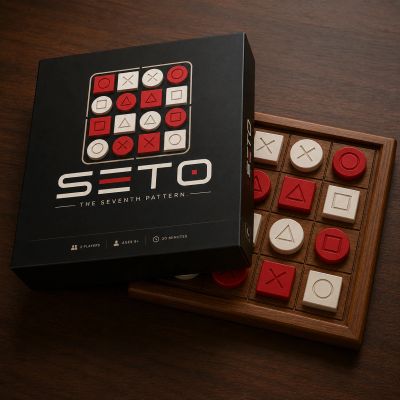
How to Play SETO
SETO in 30 Seconds
SETO is a strategy game about creating patterns, not capturing pieces.
Build scoring patterns with your pieces while preventing your opponent from completing theirs.
- White moves first.
- Players move one piece per turn.
- Most patterns use 4 pieces of the same physical shape.
- A completed 4-piece pattern scores 1 point.
- The two special 8-piece patterns score 2 points.
- First player to reach 7 points declares “SETO!” and wins.
1. Know Your Pieces
Each player has 8 pieces:
- 4 square pieces
- 4 circular pieces
Each shape carries the same four movement symbols:
Triangle (Delta) — Moves one square in any direction. May jump over one friendly piece.
Circle (Omega) — Moves one square in any direction. Cannot jump.
Square (Tetra) — Moves one square horizontally or vertically. May jump over one friendly piece.
X (Chi) — Moves one square horizontally or vertically. Cannot jump.
Remember:
The symbol controls movement.
The physical shape — circle or square — is used to form scoring patterns.
During normal play, you may never jump over an opponent's piece.
2. Set Up the Game
Each player receives all 8 pieces of one color.
To choose colors, one player secretly holds a red piece in one hand and a white piece in the other. The opponent chooses a hand.
The selected color becomes that player's color.
White always moves first.
Place all 16 pieces on the board in the official starting zigzag formation.
3. Opening — Choose Your Key
Before normal play begins, each player chooses one piece as their Key.
White opens first.
Move the chosen Key outside the board, placing it immediately beyond either end of its current row or column.
Then Red chooses and moves a Key outside in the same way.
The Key is temporarily inactive.
On that player's following turn, they must first make a normal move with another piece inside the board before the Key becomes eligible to return.
4. Normal Play
Players alternate turns.
On your turn, move one piece according to the movement symbol shown on it.
Your goal is to reposition your pieces to create one of SETO's scoring patterns while disrupting your opponent's plans.
5. Score a Pattern
SETO has 20 scoring patterns.
18 Standard Patterns — 1 Point
These patterns require exactly 4 pieces of the same physical shape:
- 4 circles, or
- 4 squares.
2 Special Patterns — 2 Points
The two special patterns require all 8 of your pieces.
Important: Only pieces completely inside the 4×4 Main Play Area can score.
6. Ace, Relay & Break
Every score immediately creates an Ace, Relays, and a Break.
Ace
The piece that makes the final move and completes the pattern becomes the Ace.
The Ace is protected during the Break.
Relays
The other pieces forming the scoring pattern are the Relays.
Break
Immediately after a score, the opponent chooses one Relay and moves it to any vacant square inside the board.
Normal movement rules do not apply to this relocation.
The Ace cannot be selected.
After completing the Break, that same opponent takes their normal turn.
Score → Break → Opponent's normal move.
7. Returning an Outside Piece
A piece outside the board can return in three ways:
Return by Vacancy
If the entry square directly in front of the outside piece becomes vacant, the owner may return the piece to that square on their turn.
- Available to all pieces
- Entry is horizontal or vertical only
- No diagonal entry
Return by Pattern
If 3 pieces inside + 1 piece outside would form a scoring pattern, the outside piece may return.
However:
No point is scored.
Instead, the opponent places that outside piece on any vacant square inside the board, then takes their normal turn.
Return by Jump
Only Triangle and Square-symbol pieces can Return by Jump.
The outside piece jumps over one adjacent friendly piece into the vacant square immediately beyond it.
Triangle: horizontal, vertical, or diagonal jump.
Square: horizontal or vertical jump only.
No chained jumps.
Vacancy vs. Jump — Remember the Difference
Return by Vacancy
All pieces can use it.
The piece enters the vacant square directly in front of it.
Horizontal or vertical only.
Return by Jump
Triangle and Square symbols only.
There must be:
Outside piece → Friendly piece → Vacant landing square
Triangle may jump horizontally, vertically, or diagonally.
Square may jump horizontally or vertically.
A diagonal return is never allowed by Vacancy. It is possible only through a legal Triangle Return by Jump.
8. Orbit
An outside piece does not have to remain in the same position.
Instead of making a normal move inside the board, you may spend your turn using Orbit.
Orbit moves an outside piece one adjacent position along the perimeter.
- One outside position per Orbit
- Horizontal or vertical movement around the perimeter
- No diagonal movement
- Orbit does not enter the board
- The entire turn is used
After using Orbit, you must make at least one normal move inside the Main Play Area before moving that same outside piece by Orbit again.
However, if that piece becomes eligible for:
- Return by Vacancy
- Return by Pattern
- Return by Jump
it may return immediately on a later turn without first making another inside move.
Orbit changes an outside position. It does not return the piece.
9. Switch
A Switch exchanges the positions of two of your pieces carrying the same movement symbol.
One must be a circle-shaped piece and the other a square-shaped piece.
A Switch is legal only when:
- Both pieces belong to the same player.
- Both carry the same symbol.
- They are horizontally or vertically adjacent.
- Both are inside the Main Play Area.
- The Switch immediately creates a valid scoring pattern.
Diagonal Switches are not allowed.
Each movement symbol — Triangle, Circle, Square, and X — may perform only one Switch per player per game.
10. Vault
Each player receives one Vault per game.
Vault allows a Triangle or Square-symbol piece to jump over one opposing piece.
Normally, jumping over an opponent is forbidden.
Triangle Vault
May Vault horizontally, vertically, or diagonally.
Square Vault
May Vault horizontally or vertically.
A Vault can be used to attack, defend, escape, or complete a scoring pattern.
Once you use your Vault, it is gone for the rest of the game.
11. Win the Game
Keep building patterns, breaking your opponent's formations, returning outside pieces, and using your special moves strategically.
The first player to reach:
7 POINTS
declares:
“SETO!”
and wins the game.