Return by Vacancy
White Player Broke the Red Player's Pattern
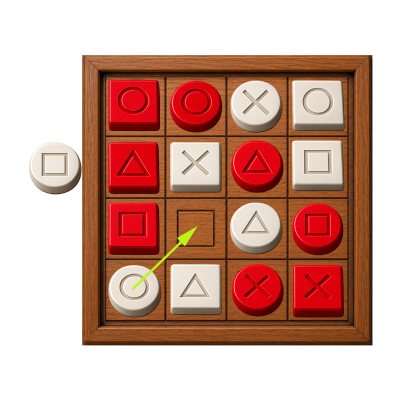
The white player breaks the red player's Diamond pattern by moving the red circular piece with the circle symbol up to the empty square. The white player then moves the white square piece with the square symbol down... perhaps setting up the next scoring pattern.
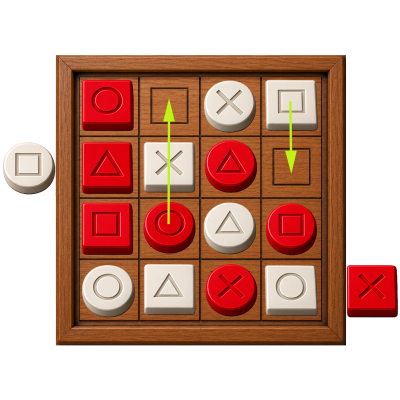
White Scores
The white square piece with the square symbol becomes the Ace, completing the Square pattern and scoring 1 point. The remaining three white pieces—the circle, triangle, and X symbols—become the Relay pieces. The red player must now break the pattern by moving any one of the Relay pieces before taking their turn.
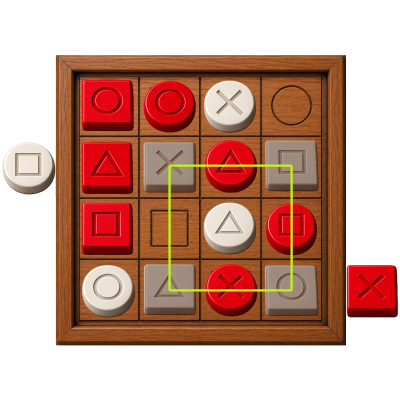
Red Player Breaks the White Square
The red player breaks the white player's Square pattern by moving the white square piece with the circle symbol to the empty square above.
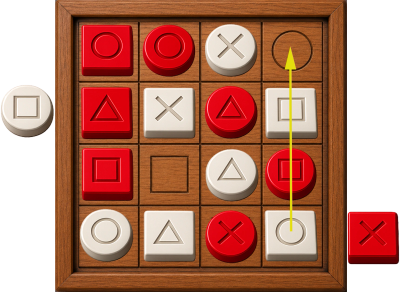
Return by Vacancy Inside the Board
This opens the entry square, allowing the red square piece with the X symbol to return to the board. Because the entry square became vacant, the red player returns their own piece to the board.
NOTE:
- Return by Vacancy → the owner returns the piece.
- Return by Pattern → the opponent returns the piece.
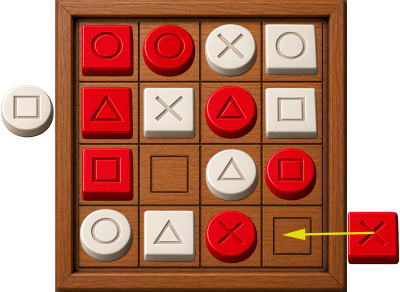
Return Completed
The red square piece with the X symbol has returned to the board. It is now the white player's turn to move.
Return by Pattern
White Square Piece with Triangle Symbol
The white square piece with the triangle symbol performs a Vault, jumping over the opposing red piece into the empty square beyond. This completes the Cross pattern with the outside Key,
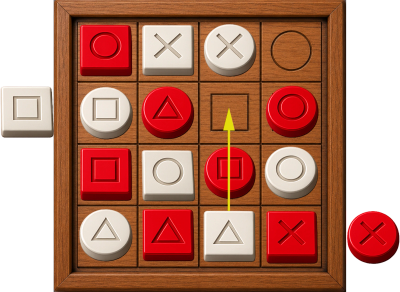
White CROSS Patterns Scored
The white player forms the Cross pattern using three pieces on the board and one Key outside the board. Since one piece is outside the 4×4 Main Play Area, no point is awarded. Instead, the red player performs a Return by Pattern by placing the outside Key on any available square inside the board before taking their turn.
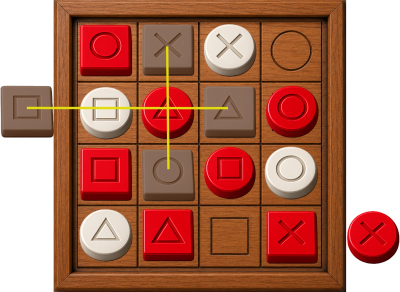
The RETURN is Performed by the Red Player
The red player completes the Return by Pattern by placing the white Key on any available square inside the board, breaking the pattern. The red player then proceeds with their turn.
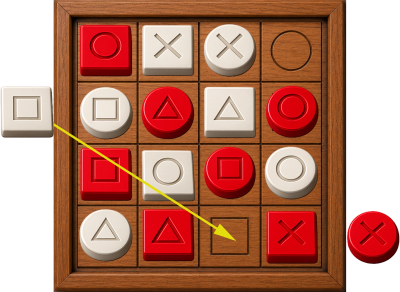
Return by Jump
Triangle Symbol – Diagonal Horizontal & Vertical Jump
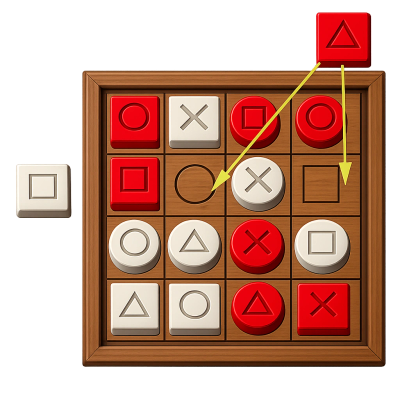
The Triangle Symbol may return to the Main Play Area by jumping over one adjacent friendly piece positioned directly in front of it. The jumped piece must be the same color, and the landing square immediately beyond it must be vacant. The Triangle Symbol may perform horizontal, vertical, or diagonal return jumps. The diagram demonstrates vertical and diagonal return jumps.
Square Symbol – Horizontal & Vertical Jump
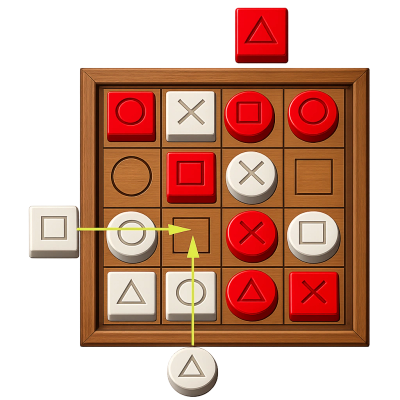
The Square Symbol may return to the Main Play Area by jumping over one adjacent friendly piece positioned directly in front of it. The jumped piece must be the same color, and the landing square immediately beyond it must be vacant. Horizontal and vertical jumps are permitted.
Return by Eclipse
Return by Eclipse (Orbital Switch)
A Return by Eclipse occurs when an orbiting piece is horizontally or vertically aligned with a same-colour piece inside the Main Play Area carrying the same symbol.
The Eclipse position may develop in any order. The orbiting piece may move into alignment last, the inside piece may move into position last, or another piece may complete the required arrangement. What matters is that the complete Eclipse position exists.
The orbiting piece may then switch with the aligned inside piece:
The orbiting piece enters the Main Play Area.
The aligned inside piece moves outside and takes its place.
Both pieces must be the same colour and carry the same symbol.
The exchange must immediately complete a valid four-piece or eight-piece pattern.
A Return by Eclipse is permitted only when it creates a scoring pattern. Therefore, the completed pattern is automatically scored: one point for a four-piece pattern or two points for an eight-piece pattern.
Example: Three square-shaped pieces are positioned to form a Cross, but the fourth position contains a circle-shaped piece carrying a Triangle symbol. A same-colour, square-shaped Triangle piece is orbiting outside and becomes horizontally or vertically aligned with it. The two pieces switch: the square-shaped Triangle enters, the circle-shaped Triangle moves outside, and the completed Cross scores one point.
Scoring After Returns
Return by Vacancy: If the returning piece completes a valid pattern upon entering, that pattern scores.
Return by Jump: If the returning piece lands on a square that completes a valid pattern, that pattern scores.
Return by Pattern: The original arrangement involving pieces inside and outside does not score. However, if placing the returned piece inside completes a separate valid pattern, that new pattern scores.
Return by Eclipse: The return must complete a valid pattern; therefore, every legal Eclipse scores automatically.

NOTE:
Return by Vacancy and Return by Jump are different return methods. Return by Vacancy applies to all pieces. A piece may return only to the vacant entry square directly in front of it (horizontal or vertical only). No piece may return diagonally by Return by Vacancy, even if it normally moves diagonally. Return by Jump applies only to the Triangle and Square Symbols. When returning by jump, these pieces follow exactly the same jump rules used inside the Main Play Area. The jump is permitted only if there is one adjacent friendly piece to jump over and the square immediately beyond it is vacant. Therefore, the Triangle may jump horizontally, vertically, or diagonally, while the Square may jump horizontally or vertically only. A diagonal return is never allowed by Return by Vacancy—it is allowed only as a legal Return by Jump.