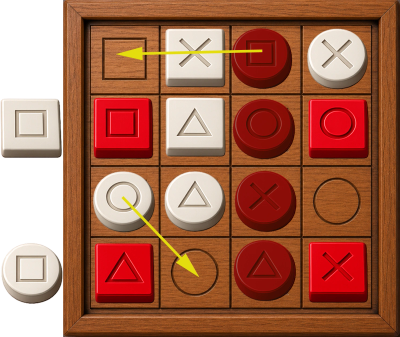
The Vertical Switch
The Vertical Switch with Square Symbols
In this example, the Switch is performed between the red square piece and the red circular piece, both bearing the square movement symbol. The two pieces exchange positions vertically, as indicated by the arrows. The Switch is permitted because the exchange immediately forms a valid scoring pattern, as illustrated in the following figure.
A Switch may be performed only if all of the following conditions are satisfied:
- A Switch may be performed only between two pieces belonging to the same player that bear the same movement symbol.
- The two pieces must be adjacent horizontally or vertically. Diagonal Switches are not permitted.
- The Switch must immediately form a valid scoring pattern. Otherwise, it cannot be performed.
- All pieces participating in the Switch and the resulting scoring pattern must be positioned inside the Main Play Area (4×4 board).
- Each movement symbol (Triangle, Circle, Square, and X) may perform only one Switch per player during a game.
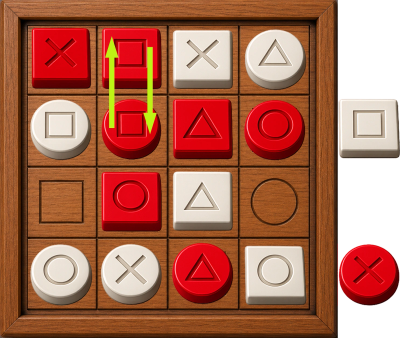
Small Heart Pattern Formed After the Switch
In this example, the Small Heart pattern has just been completed by the red player. Before normal gameplay continues, the white player must perform a Break by selecting and relocating one Relay piece from the completed pattern to any vacant square on the board. The Ace, which is the last piece moved to complete the pattern, cannot be relocated during the Break. After completing the Break, the same white player immediately performs a normal move, after which play returns to the red player.
This sequence ensures that every completed scoring pattern is disrupted before play resumes, preventing players from repeatedly scoring the same pattern without rebuilding it.
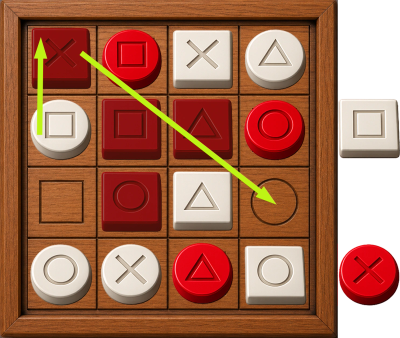
The Horizontal Switch
The Horizontal Switch with Circle Symbols
In this example, the red square piece and the red circular piece, both bearing the Circle movement symbol, perform a horizontal Switch by exchanging positions. The Switch is permitted because the exchange immediately forms the Bridgescoring pattern, as illustrated in the following figure.
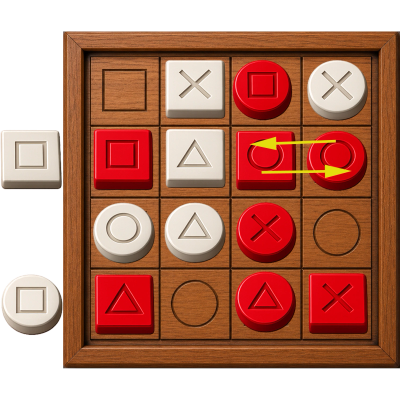
Bridge Patter Formed After The Switch
Following the horizontal Switch, the Bridge pattern is formed and scored. The last piece moved becomes the Ace, while the remaining pieces become the Relay. The opposing player (White) must then perform a Break by relocating any Relay piece except the Ace. In this example, the White player moves the red circular piece bearing the Square movement symbol to a vacant square, then immediately makes a normal move with the white circular piece bearing the Circle movement symbol.